Blog
Does Turmeric in JointVance Help Knee Arthritis Pain? What the Studies Say
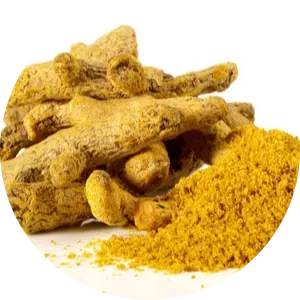
Early studies look promising. NCCIH says meta-analyses of oral turmeric or curcumin for knee osteoarthritis point in a positive direction, but better studies are needed (NCCIH, Turmeric). MSKCC notes trials where it matched common pain relievers, yet it did not change cartilage on scans (MSKCC, Turmeric). JointVance holds 105 mg of turmeric extracts a capsule, and our sources print no trial dose to compare.
Written by the JointVance editorial teamUpdated · 9 min read
Short answer
Does turmeric help knee pain?
It may help a little. The research leans positive, but most of it is small, and experts want stronger trials (NCCIH, Turmeric).
- Pain and stiffness: pooled studies of knee osteoarthritis point toward some benefit.
- Versus pain relievers: some trials found turmeric about as helpful as acetaminophen or an NSAID (MSKCC, Turmeric).
- Cartilage: scans showed no change in knee cartilage or joint swelling (MSKCC, Turmeric).
- JointVance itself: no trial of the finished capsule has been published.
Government review
What does NCCIH say about turmeric for knee osteoarthritis?
NCCIH, part of the National Institutes of Health, calls the early evidence positive. It also says higher-quality evidence is needed (NCCIH, Turmeric). That is a careful "maybe," not a green light.
The verdict rests on meta-analyses, which pool many trials into one average and are only as strong as those trials.
| Question | What NCCIH reports |
|---|---|
| What was measured | Knee pain, stiffness, strength and mobility |
| Form tested | Turmeric or curcumin taken by mouth |
| Overall verdict | Initial evidence positive; higher-quality evidence needed |
| Creams and gels | Effect of curcumin on the skin is unclear |
| Trial doses | Not given in our sources |
On the meter below, turmeric scores highest of the three JointVance ingredients and still sits mid-scale.
Head to head
Is turmeric as good as pain relievers for arthritis?
In some studies it was. Memorial Sloan Kettering Cancer Center (MSKCC) reports trials where turmeric was safe and about as effective as paracetamol, also called acetaminophen, or an NSAID for knee osteoarthritis (MSKCC, Turmeric).
Comfort scores
Knee pain and function improved about as much as with common pain relievers in the trials MSKCC describes.
Joint swelling on scans
Turmeric did not change knee effusion-synovitis, the fluid and lining swelling that imaging can show.
Cartilage
Cartilage composition did not change either. Turmeric may ease how a knee feels, not how it is built.
Those were comfort scores, so a turmeric capsule is no stand-in for a medicine your doctor chose. Keep taking your prescribed medicine. Never stop or change a dose on your own.
Activity, a healthy weight and physical therapy remain the core of osteoarthritis care (CDC, Osteoarthritis). A supplement sits beside those steps.
Buyer beware
Why do turmeric supplements vary so much?
Because "turmeric" on a label can mean very different things. NCCIH warns that products vary in how much curcumin they contain (NCCIH, Turmeric).
Ground root, a concentrated extract and a standardized extract can share the same milligrams and still hold very different amounts of curcumin.
| Label line | Amount | What it tells you | What it leaves open |
|---|---|---|---|
| Turmeric root extract 4:1 | 75 mg | A concentrated extract; the ratio usually means about 4 parts root per 1 part extract | Curcumin share not printed |
| Turmeric root extract, 95% curcuminoids | 30 mg | Standardized, so about 28.5 mg of curcuminoids | Nothing major; the math is on the label |
| Both lines together | 105 mg | Total turmeric extract per capsule | Total curcuminoids not printed |
The turmeric ingredient profile compares both extract types in more depth.
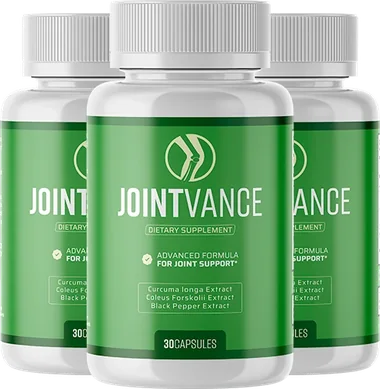
Try JointVance for 60 days1 capsule a day · 30 capsules per bottle · price shown at checkout
Order nowAbsorption
Why is black pepper added to turmeric?
To help the body take curcumin in. NCCIH notes that curcumin is often paired with piperine, the sharp compound in black pepper, which can improve absorption (NCCIH, Turmeric).
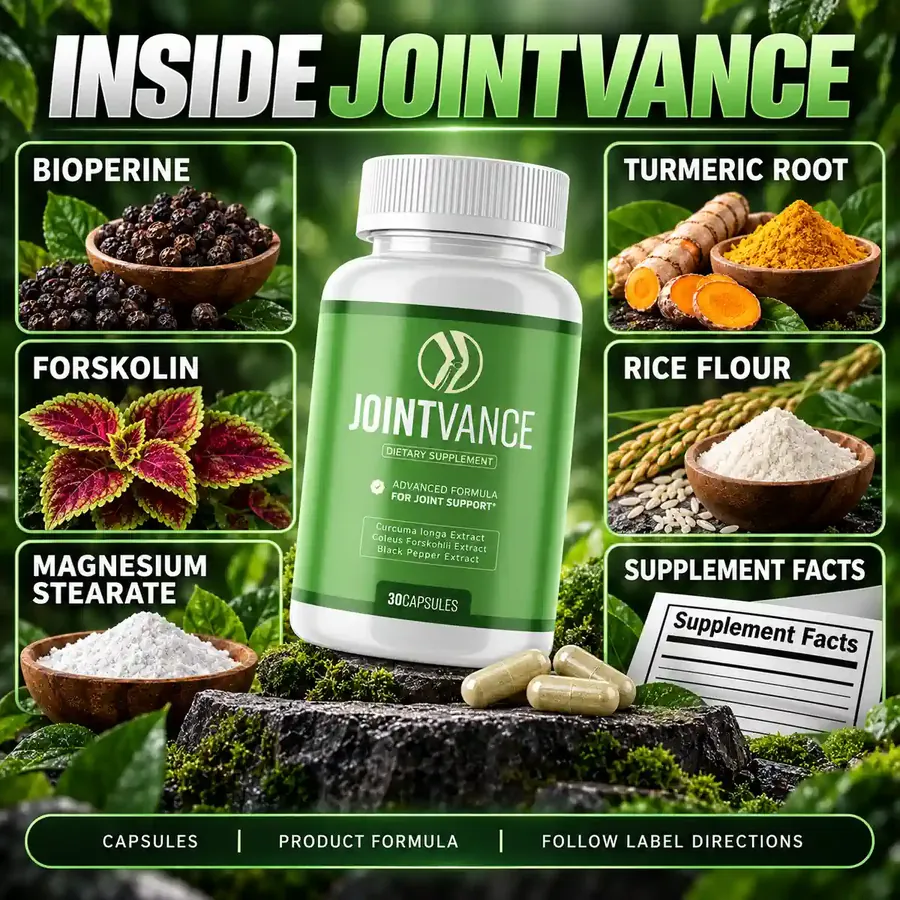
JointVance adds black pepper extract sold as BioPerine for that reason. The label prints its amount as "5 g", which cannot fit in one capsule, so 5 mg is almost certainly meant. Ask the distributor to confirm, or read our black pepper extract page.
The same NCCIH page warns that highly bioavailable curcumin may harm the liver, and liver injury has been reported. Stop and call a provider for unusual tiredness, nausea, poor appetite, dark urine or yellow skin or eyes (NCCIH, Turmeric).
MSKCC adds that rare liver injury reports, some with low-dose products, cleared up after people stopped (MSKCC, Turmeric).
Dose check
Is 105 mg of turmeric enough for joint pain?
Nobody can say from the evidence we cite. Our sources print no trial dose, so we cannot hold 105 mg up against a study number.
What we can say is that 105 mg of extract is a modest amount for a turmeric product. The bottle makes that easy to see, because there is no proprietary blend hiding the split.
Start with the clear line
30 mg at 95% curcuminoids gives about 28.5 mg of curcuminoids per capsule.
Add the open line
The 75 mg 4:1 extract adds more turmeric, but its curcumin share is not printed.
For the full panel, read the JointVance Supplement Facts breakdown.
Bottom line
How should you judge a turmeric supplement for joint pain?
Judge it on the label, the safety fit and your own notes.
- Look for a curcuminoid percentage on at least one line.
- Check for black pepper extract, which raises the liver caution along with absorption.
- Ask a pharmacist first if you take a blood thinner, since turmeric may raise bleeding risk (MSKCC, Turmeric). Read our turmeric and blood thinners guide.
- Rate stairs, morning stiffness and a short walk weekly for eight weeks, as the results timeline explains.
- Do not take turmeric supplements while pregnant unless your doctor agrees; NCCIH says they may be unsafe then (NCCIH, Turmeric).
Two to three months is a fair trial. If nothing has changed by then, the answer is probably no for you.
Sources
- Turmeric. National Center for Complementary and Integrative Health, 2026.Meta-analyses of oral turmeric or curcumin for knee osteoarthritis: initial evidence positive, higher-quality evidence needed. Products vary in curcumin content; piperine can improve absorption; highly bioavailable formulations may harm the liver (watch for fatigue, nausea, poor appetite, dark urine, jaundice). Nausea, reflux, diarrhea. Usual oral forms likely safe for 2-3 months. Supplements may be unsafe in pregnancy.
- Turmeric. Memorial Sloan Kettering Cancer Center, About Herbs, 2026.Found safe and as effective as paracetamol or an NSAID for knee osteoarthritis in studies; did not affect knee effusion-synovitis or cartilage composition. May increase bleeding risk with warfarin and other blood thinners; interferes with CYP450 (3A4); may increase tacrolimus side effects; kidney-stone-prone patients consult a physician; liver injury reports resolved after stopping.
FAQ
Turmeric for joint pain: common questions
How strong is the evidence for turmeric for knee arthritis?
It is promising but not strong yet. NCCIH says meta-analyses on knee osteoarthritis lean positive, yet it still calls for higher-quality trials (NCCIH, Turmeric). Many studies were small, so the true size of any benefit is unknown.
How much curcumin per day for joint pain?
Our sources give no study dose, so we quote none. Look for a curcuminoid percentage on the label. In JointVance, the 30 mg line at 95% gives about 28.5 mg of curcuminoids, plus a 4:1 extract with no curcumin figure.
Is turmeric better than ibuprofen for knee pain?
Not better. Some trials found it about as effective as an NSAID such as ibuprofen, or acetaminophen, for knee osteoarthritis (MSKCC, Turmeric). That is no proof for any one product, so keep the pain reliever your doctor chose.
Does turmeric repair joint cartilage?
No. MSKCC reports that turmeric did not change cartilage composition or joint swelling on knee scans (MSKCC, Turmeric). Any benefit is in how the joint feels. Pages that promise cartilage regrowth go beyond the studies.
What is the difference between turmeric and curcumin?
Turmeric is the whole root, used as a spice. Curcumin is its best-studied compound, one of a group called curcuminoids. Raw turmeric holds only a small share, so many supplements use extracts standardized to a stated percentage.
Can you take turmeric every day for arthritis?
For most adults, yes, for a while. NCCIH says usual oral forms are likely safe in recommended amounts for 2 to 3 months (NCCIH, Turmeric). Longer use has less data. Check with a doctor first if you have liver disease or take a blood thinner.
Does turmeric in Joint Vance work for knee pain?
Early studies on turmeric look promising, but no study has tested the Joint Vance formula itself. Each capsule holds 105 mg of turmeric extracts, and the sources used here print no trial dose to compare.
Why does JointVance add black pepper to turmeric?
Black pepper extract is added to help with absorption of turmeric. The page covers why products differ in absorption and how to judge a turmeric supplement for joint comfort.
Who wrote this
Written and reviewed by
Plain-language pages built from the label, the sales page and linked public health sources.
Last updated . Read our editorial standards and how we check reviews. This website is run by a U.S. retailer that sells JointVance, not by the manufacturer (the label says distributed for Joint Vance, Lakeland, FL). We earn money when you buy through our order links.
Keep reading
More about JointVance
Turmeric and curcumin
Both JointVance turmeric extracts, what knee studies found, and the liver and bleeding cautions to know first.
Read more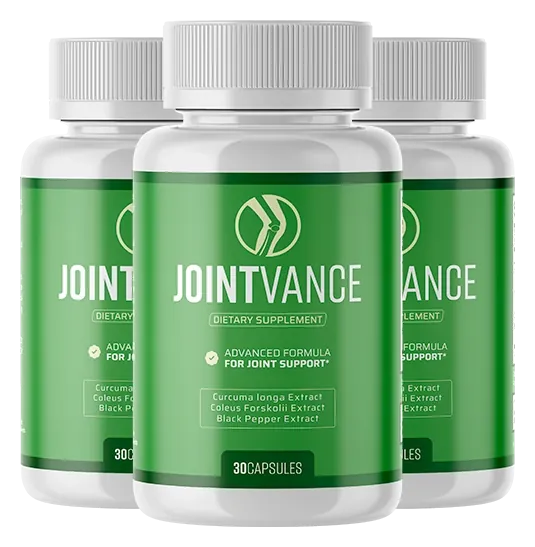
Turmeric and blood thinners
Why turmeric and forskolin carry bleeding warnings, what to do before surgery, and a list to show your pharmacist.
Read moreResults timeline
An honest 8-week JointVance plan: what to measure each week, when to decide, and when to stop.
Read moreUSA Authorized JointVance Retailer
Ready to try JointVance?
Pick a pack. One capsule a day; each bottle is 30 days. The order page shows the price and shipping before you pay.
- Secure checkout
- 60-day window
- Ships from the U.S. with tracking